Updated guidance for organisations on building a defensible data protection record: what to document, what to measure, and what to show regulators, partners, and customers.
In 2026, data protection compliance is no longer judged by what your privacy policy says. It is judged by what you can prove on demand: decisions, controls, logs, contracts, and records. Organisations that cannot produce a credible privacy evidence pack quickly will struggle under regulator questions, enterprise procurement scrutiny, or post-incident review.
Bottom line: Build a privacy evidence pack that lets you answer due diligence and audit questions fast, without scrambling across email threads and spreadsheets.
Contents
- What a privacy evidence pack is and why it matters in 2026
- The 10 privacy artifacts every organisation should have
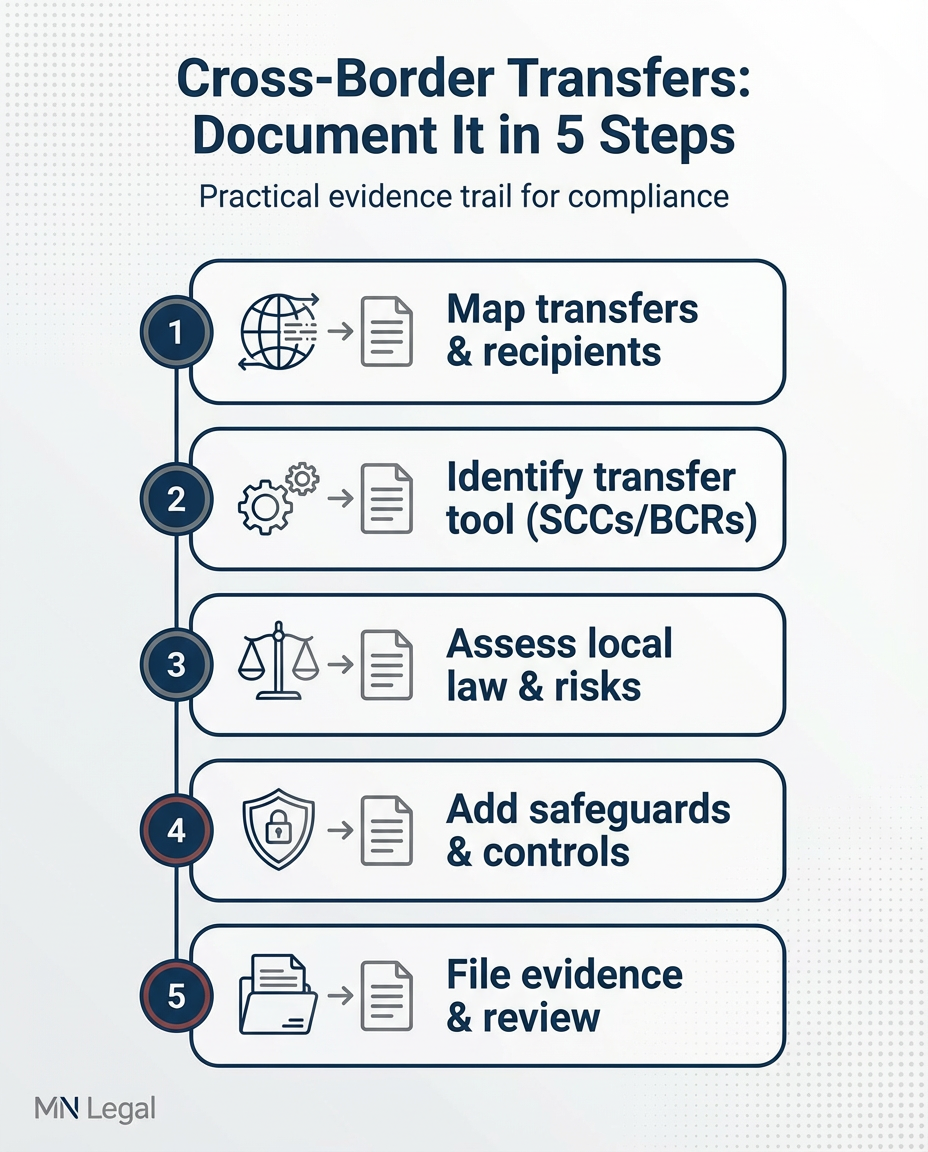
- Cross-border data transfers: document it in 5 steps
- AI and privacy: 7 controls for teams using AI tools
- How to run privacy as a system: cadence and KPIs
- FAQ
1. What a Privacy Evidence Pack Is and Why It Matters in 2026
A privacy evidence pack is the set of materials that demonstrate how your organisation manages personal data in practice, not just in policy. It is what makes data protection auditable and defensible internally (board oversight), externally (partners and enterprise customers), and regulator-facing (when questions arise).
This matters globally because privacy regimes differ in their details but converge on a shared expectation: accountability, transparency, and demonstrable controls. Whether you are subject to Kenya’s Data Protection Act, the GDPR, or equivalent frameworks, the evidence standard is broadly the same.
2. The 10 Privacy Artifacts Every Organisation Should Have (2026)
If you want a documentation standard that travels well across jurisdictions, focus on artifacts that satisfy multiple regulatory frameworks simultaneously. These ten items form a practical baseline for any organisation handling personal data.
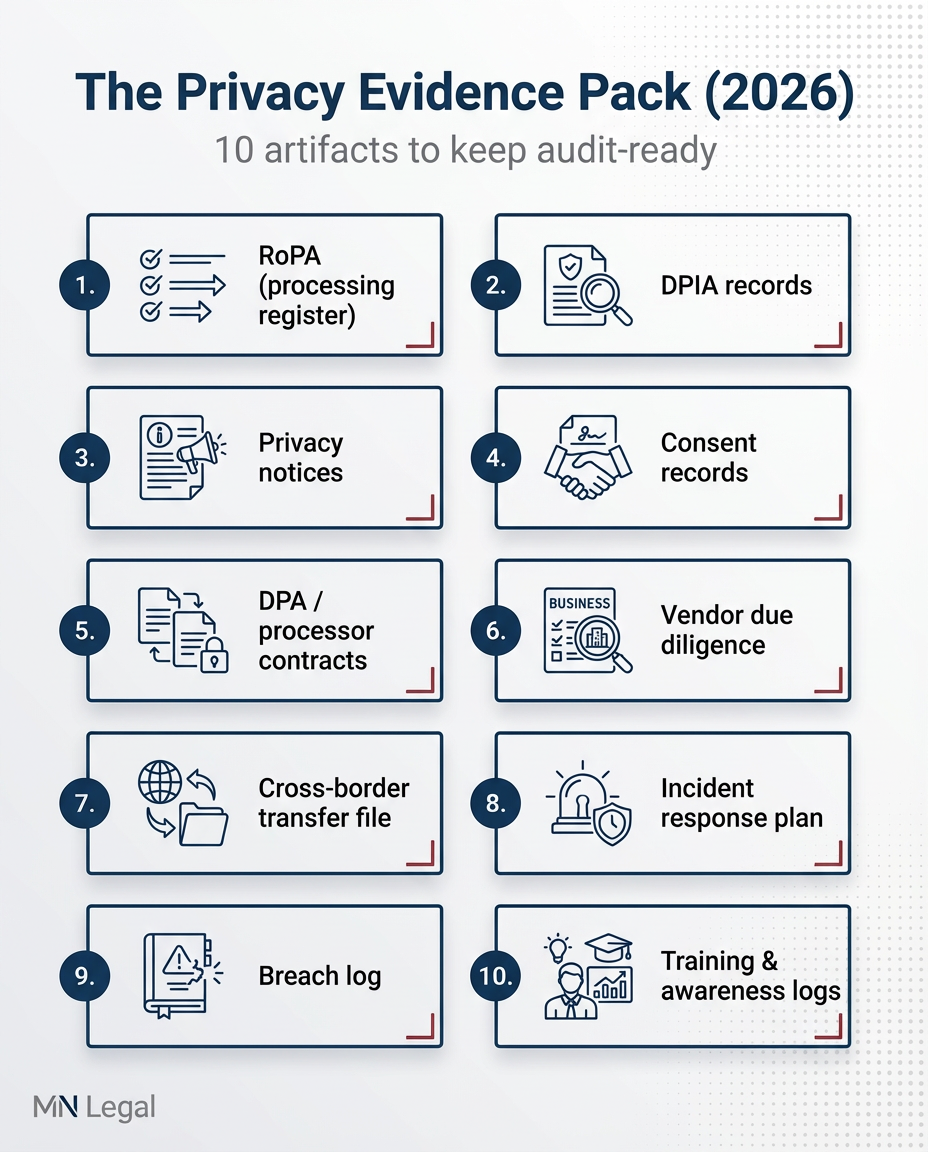
What “Good” Looks Like Across All 10 Artifacts
- Owned: each artifact has a named owner and a defined review cadence.
- Current: updated whenever vendors, products, or data flows change.
- Provable: you can show records and decisions, not just policy statements.
3. Cross-Border Data Transfers: Document It in 5 Steps
Most organisations transfer personal data across borders without recognising it as a transfer. Cloud hosting, CRMs, helpdesks, analytics platforms, marketing tools, and AI vendors can all create cross-border data flows that require documentation and appropriate safeguards.
Practical Tip
Start with your top ten vendors ranked by data sensitivity and volume. Do not attempt to perfect the entire map at once. Get a defensible baseline documented first, then iterate as you onboard new tools or expand into new markets.
4. AI and Privacy: 7 Controls for Teams Using AI Tools
In 2026, many organisations face a data protection risk that did not exist at the same scale a few years ago: everyday data leakage into AI tools through prompts, file uploads, meeting notes, transcripts, and customer tickets. AI adoption also increases vendor complexity and creates new cross-border transfer obligations.
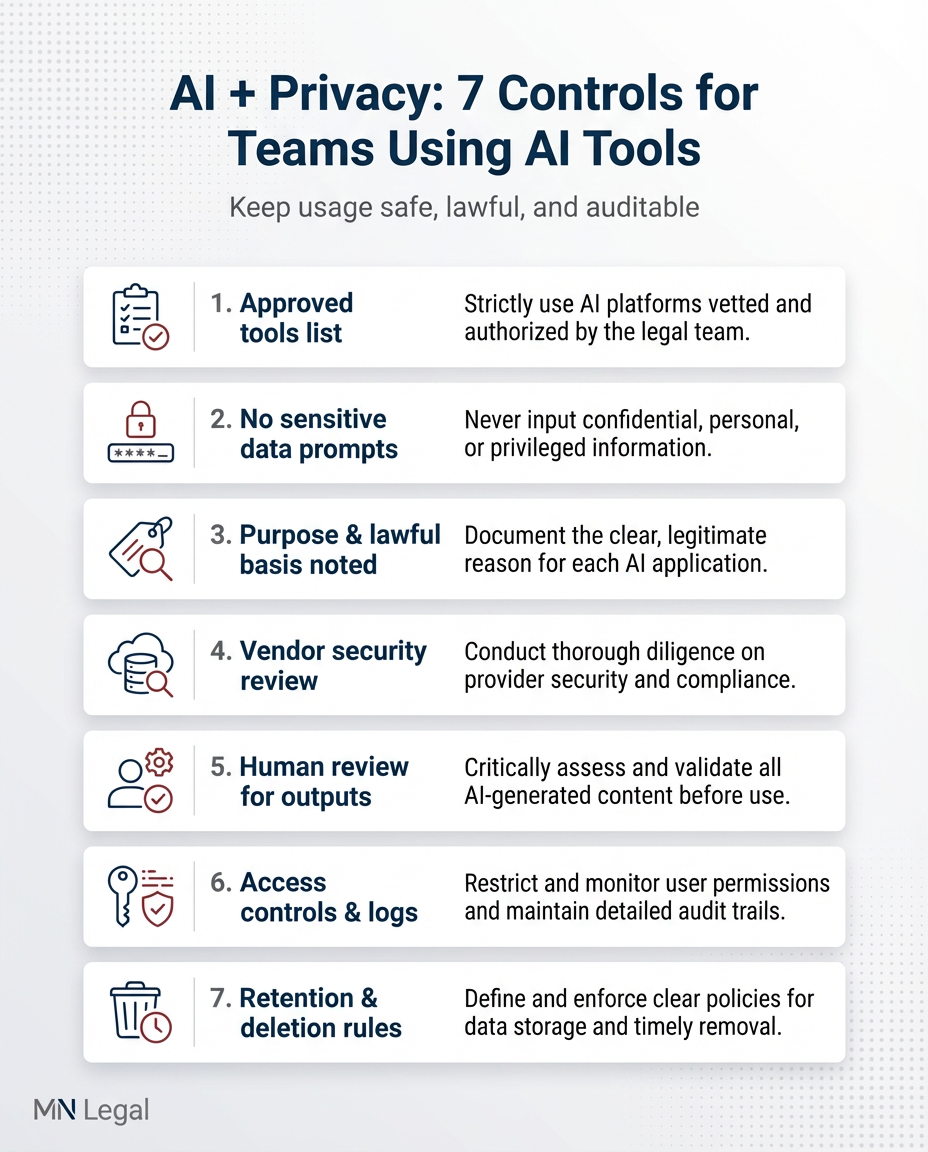
Minimum Documentation for AI Use
- AI use register: tool name, purpose, owner, data input types, and risk classification.
- Data entry restrictions: a clear record of what categories of data cannot be entered into external AI tools.
- Vendor controls: data retention terms, training-use clauses, incident notification obligations, and sub-processor lists.
5. How to Run Privacy as a System: Cadence and KPIs
Monthly Review
- Vendor changes and newly adopted tools, especially AI tools.
- New processing activities arising from product or service changes.
- Open data subject rights requests and incident log review.
Quarterly Review
- High-risk processing review: DPIAs and PIAs for new or changed activities.
- Cross-border transfer review for top vendors.
- Board and leadership privacy report covering risks, incidents, and remediation status.
KPIs That Are Practical to Track
- Average time to complete data subject rights requests.
- Percentage of critical vendors with signed DPAs and documented transfer safeguards.
- Time-to-triage for incidents and time-to-close for remediation actions.
- Percentage of teams trained and completion rate of AI-use controls.
Need This Implemented in Your Organisation?
MN Legal supports privacy evidence-pack readiness, vendor and cross-border transfer contracting, AI governance controls, and breach readiness so your organisation can demonstrate compliance efficiently when it matters most.
Make an enquiry | Explore Practice Areas
Key References
- Council of Europe: Data Protection Day
- EDPB guidance
- ICO (UK) guidance
- OECD privacy resources
- NIST Privacy Framework
Frequently Asked Questions
What is a privacy evidence pack?
A privacy evidence pack is the set of documents, logs, and records that prove how your organisation manages personal data in practice, going beyond policy statements alone. It typically includes your processing register, DPIAs, vendor DPAs, incident log, data subject rights log, retention schedule, and staff training records.
Does our organisation need a DPIA?
A DPIA is most valuable when processing is likely to create high risk for individuals. For example, large-scale processing of sensitive data, profiling, automated decision-making, or the use of new technologies. It is also strong evidence that you assessed risks and implemented appropriate controls before processing began.
How should we handle cross-border data transfers in 2026?
Map your transfers by system, vendor, and destination country. Identify the legal mechanism and safeguards applicable to each transfer, document your risk assessment, ensure appropriate contractual clauses are in place, and maintain an evidence trail of approvals and periodic reviews.
What should we do about staff using AI tools with personal data?
Maintain an AI use register, establish clear restrictions on what data categories may be entered into external tools, implement vendor procurement and contractual controls, require human review for high-impact AI outputs, and keep an audit trail for high-risk use cases.
What do regulators and procurement teams ask for during due diligence?
Common requests include your processing register, privacy notices, completed DPIAs, vendor DPAs and transfer documentation, a security measures summary, your incident response plan and incident log, and records of data subject rights requests and staff training completion.
How can MN Legal help with data protection compliance?
MN Legal supports privacy programme design and evidence-pack readiness, vendor and cross-border transfer contracting, AI governance controls, and incident readiness so organisations can demonstrate compliance efficiently when facing regulators, partners, or post-incident scrutiny.
Disclaimer: This article is for general information only and does not constitute legal advice. Requirements vary by jurisdiction and specific facts. For advice on your organisation’s situation, contact MN Legal.
Download: Privacy Evidence Pack Checklist (2026)
A one-page index of the 10 artifacts and logs your organisation should be able to produce on demand. Built for international organisations operating across multiple jurisdictions.
Download PDF Checklist