


Employing People in Kenya: A Legal Compliance Guide for Foreign Companies and Growing SMEs
The first hire in a new market is where many foreign employers discover that employment law has practical consequences. Kenya’s employment framework is procedurally demanding, statutory in its obligations, and increasingly data-aware. Getting it right from the start is measurably cheaper than correcting it under pressure.

This guide covers the compliance areas that matter most for foreign employers: classification, contracts, statutory setup, work permits, employee data, and termination procedure. It includes sector notes for technology, professional services, and manufacturing, and is accompanied by a downloadable employer compliance checklist.
Practical framing: Many employment disputes and compliance exposures that reach lawyers are preventable. They typically result from one of three failures: the wrong classification, an absent or deficient contract, or a termination handled without following the required procedure.
1) Employee or contractor: get this right first
Classification is the decision that precedes every other employment compliance question. It determines which statutory deductions apply, what rights the individual holds, and whether unfair dismissal protections are available. Critically, a written agreement that describes someone as a contractor does not, on its own, determine their legal status.
Kenyan courts and the Employment and Labour Relations Court look at the substance of the relationship, not the label. A person who works exclusively for one business, uses the business’s tools, is integrated into its operations, and has tax deducted at source is likely to be treated as an employee regardless of what the agreement says.
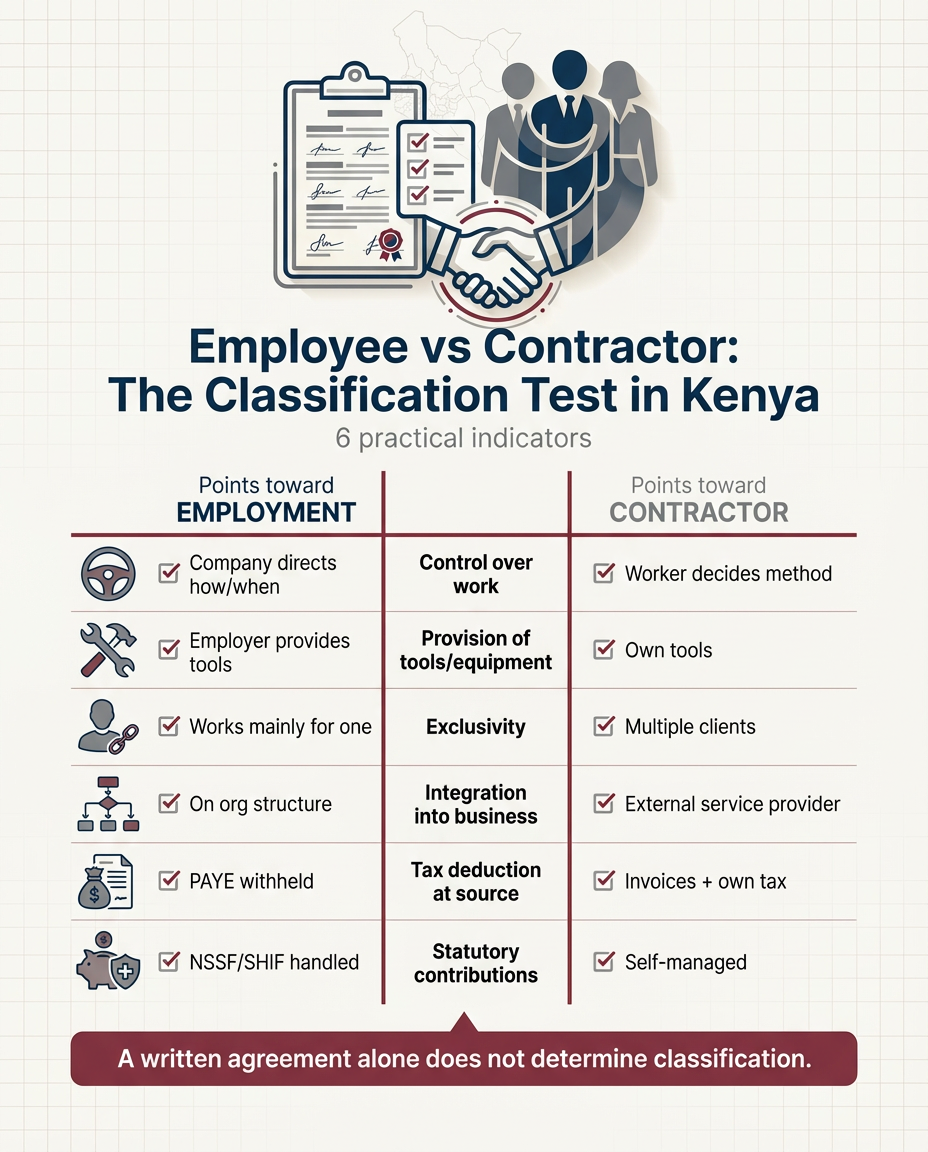
The practical risk of misclassification is threefold: unpaid statutory contributions and associated penalties, tax exposure, and unfair dismissal claims if the engagement is terminated without following the employment procedure. Many foreign employers inherit this risk from early-stage arrangements that were not revisited as the engagement matured.
Practical action: If you have contractors who work exclusively for your business, have been engaged for more than a few months, and are integrated into your workflows, review their classification before scaling or restructuring.
2) The employment contract: what must be in writing
Kenya’s Employment Act requires that certain information be provided to an employee in writing. Foreign employers often use home-country templates which typically miss Kenya-specific requirements and can create enforceability gaps or ambiguity on termination, post-employment obligations, and dispute resolution.
A compliant Kenya employment contract should address the nature of the employment and probation period, remuneration and the basis of payment, working hours and leave entitlements, notice periods and termination conditions, governing law and the forum for disputes, and any post-employment restrictions. Where the employer intends to rely on confidentiality obligations or non-solicitation provisions, these must be proportionate and clearly drafted to have a reasonable prospect of enforcement in a Kenyan court.
Non-compete clauses deserve particular attention. Kenyan courts apply a reasonableness standard and have in a number of decisions declined to enforce broad or disproportionate restraints. The clause must be limited in scope, geography, and duration to have a realistic chance of standing.
3) Statutory registrations and payroll setup
Before the first payroll run, three statutory frameworks require attention: PAYE administered through KRA, NSSF contributions, and SHIF contributions which replaced the former NHIF structure. These obligations arise at the point of hiring and late or missing remittances attract penalties.
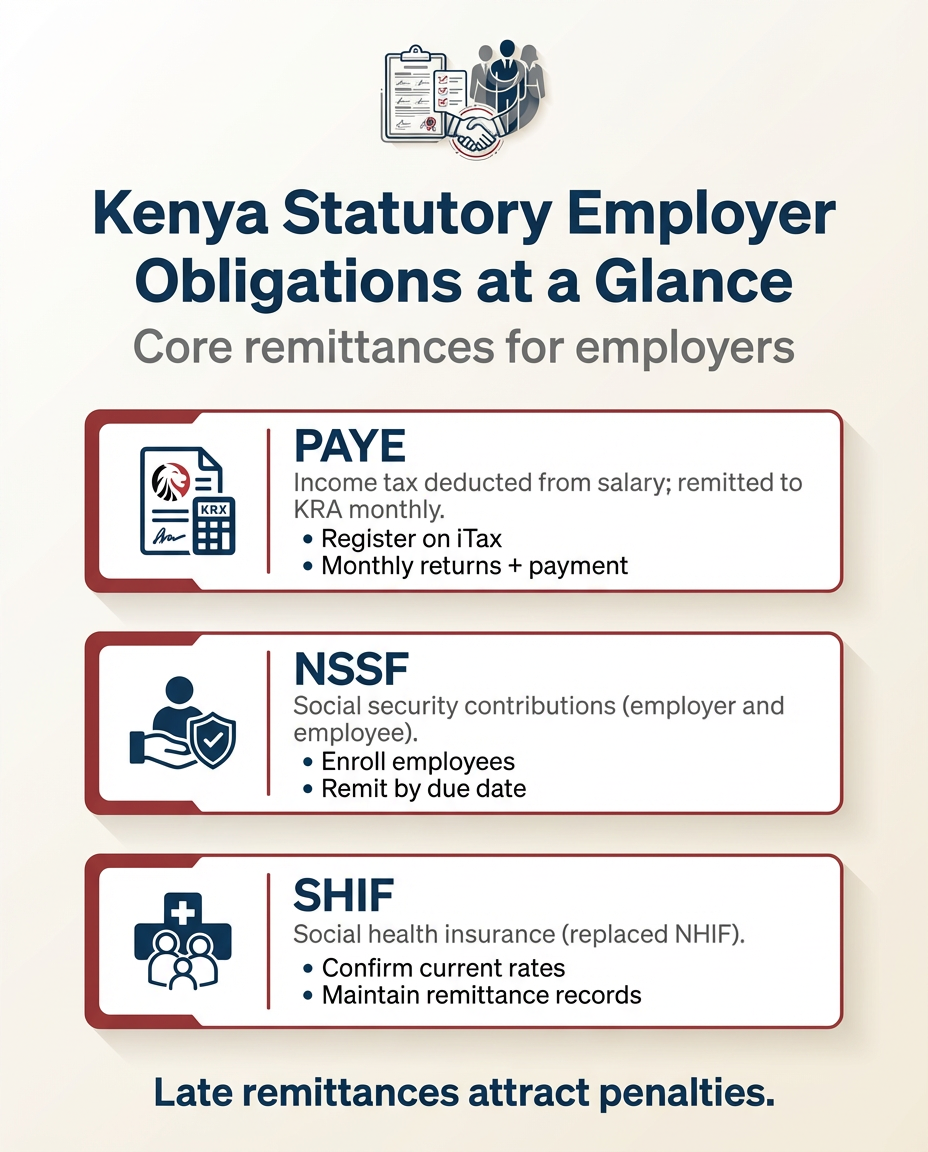
Beyond the mechanics of remittance, payroll compliance also requires accurate and timely payslips, recordkeeping for audit purposes, and the ability to produce records on demand from regulators or in litigation. Foreign employers should confirm that their payroll systems can generate Kenya-compliant outputs from day one.
Key references: Kenya Revenue Authority, NSSF, and SHIF.
4) Work permits and immigration for foreign staff
Foreign nationals working in Kenya require an appropriate work authorisation before commencing employment. The permit category depends on the nature of the role, the level of the individual, and in some cases the sector. Permit applications involve documentation of the employer, the role, and the individual, and timelines should be factored into hiring plans.
Kenya’s immigration framework also engages citizen-to-foreigner ratio considerations in certain sectors. Foreign employers should confirm the applicable requirements for their industry before making overseas hires and should treat permit renewals as a calendar-managed compliance item, not an ad hoc task.
Reference: Department of Immigration Services.
Practical tip: Start work permit applications as early as possible. Processing times can affect onboarding plans, and a foreign employee working without the correct authorisation creates legal risk for the employer.
5) HR data and employee privacy
Employment generates significant personal data: identity documents, payroll records, performance history, health information, device and system access logs, and in some cases location data or biometric attendance records. Kenya’s data protection framework applies to this data, and employers should not assume that existing home-country privacy notices and policies are sufficient.
A defensible employment data posture includes a clear HR privacy notice that tells employees what data is collected, why, how long it is retained, and who it is shared with. It also requires appropriate vendor terms for payroll providers, HR platforms, and cloud-based systems. Where biometric data is used for attendance or access control, a higher standard of care is required, including risk assessment and documented justification.
The ODPC has published guidance and issued determinations that are relevant to employer data practices. The safest approach is to treat HR data compliance as part of market entry, not a post-launch consideration. Reference: Office of the Data Protection Commissioner.
6) Discipline and termination: the procedural standard
This is the area where foreign employers most frequently face exposure, because the Kenyan employment framework is procedurally demanding in a way that differs from many other jurisdictions. An employer may have a substantively valid reason for dismissal and still face an unfair dismissal finding if the required procedure was not followed.
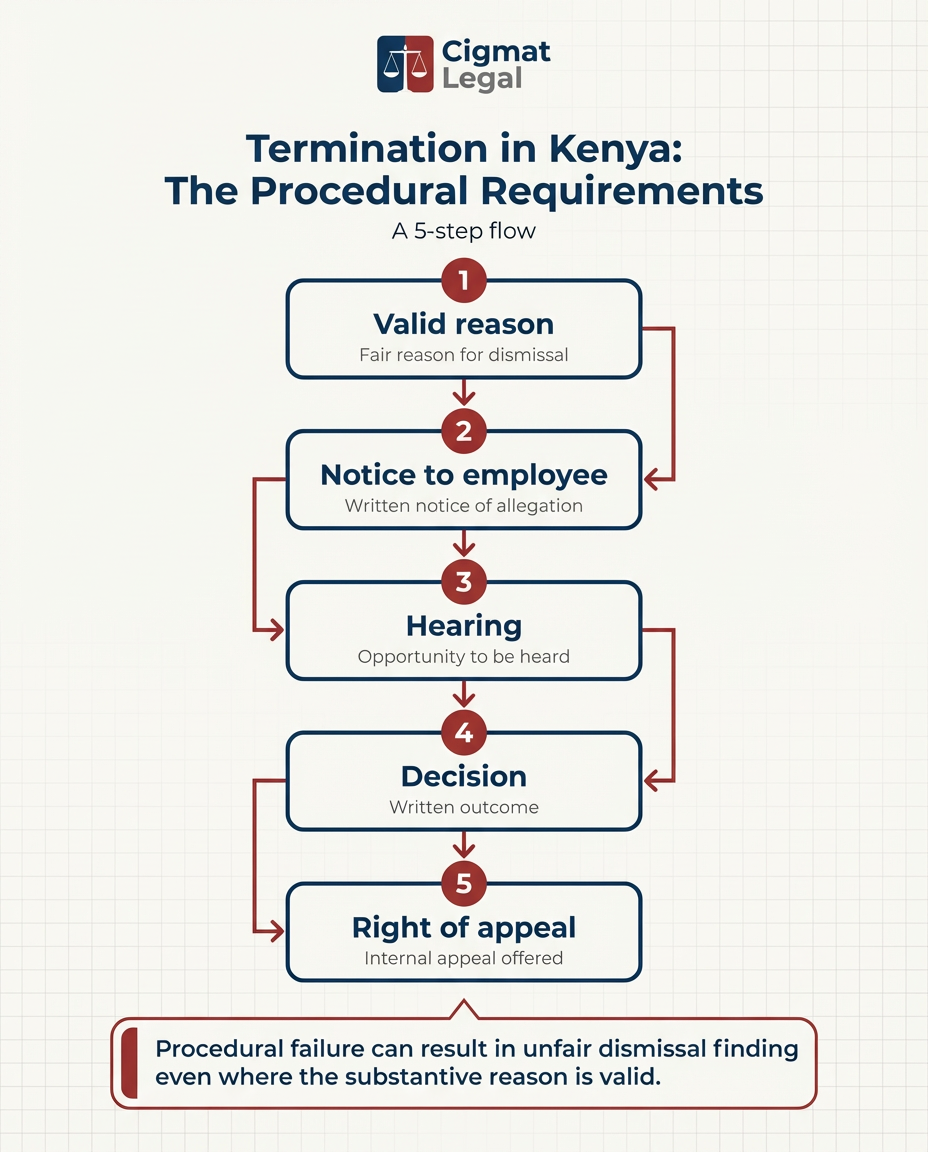
The procedure requires that the employee receives written notice of the allegation, is given a genuine opportunity to respond and be heard, receives a written decision, and is offered an internal right of appeal. Documentation at each stage is essential: if the procedure is not evidenced, it is difficult to defend.
Redundancy is separately regulated and requires a different process that includes notice to the relevant authority, notification to the union where applicable, and payment of redundancy entitlements. Foreign employers planning workforce restructuring should not apply home-country redundancy procedures in a Kenyan context.
7) What to have in place before you scale
Employment exposure grows as headcount grows. Small teams often operate on informal arrangements that become difficult to manage as the business scales. The transition point, where employment records, policies, and procedures need to be formalised, is typically earlier than most founders expect.
Practically, employers should have written contracts for all staff, an HR data policy and privacy notice, a basic disciplinary and grievance procedure, payroll records that are complete and audit-ready, and documented onboarding that includes statutory disclosures. For employers using commission-based, flexible, or non-standard arrangements, the terms should be clear, documented, and consistent with statutory minimums.
8) Sector notes
Technology and SaaS businesses
Tech businesses often rely heavily on contractor arrangements for product development and sales. Classification risk is particularly acute where contractors are embedded, exclusive, and long-term. IP assignment clauses in employment and contractor agreements are critical: the default position on who owns work created by an employee or contractor may not align with what the business intends. HR data exposure is also higher where platforms, devices, and access systems generate significant volumes of employee metadata.
Professional services businesses
Professional services firms face particular risk around restrictive covenants, client relationship ownership, and the enforceability of non-solicitation provisions when senior staff depart. Employment contracts in this sector should address client and staff solicitation, confidential information obligations, and gardening leave in a way that is proportionate and likely to be upheld.
Manufacturing and industrial businesses
Manufacturing employers should pay particular attention to working hours compliance, overtime calculations, health and safety obligations, and the statutory rules around collective bargaining where staff numbers are significant. Redundancy processes in this sector require careful management given union engagement obligations and the reputational and operational risks of a poorly handled workforce restructuring.
9) Download the Kenya Employer Legal Compliance Checklist (2026)
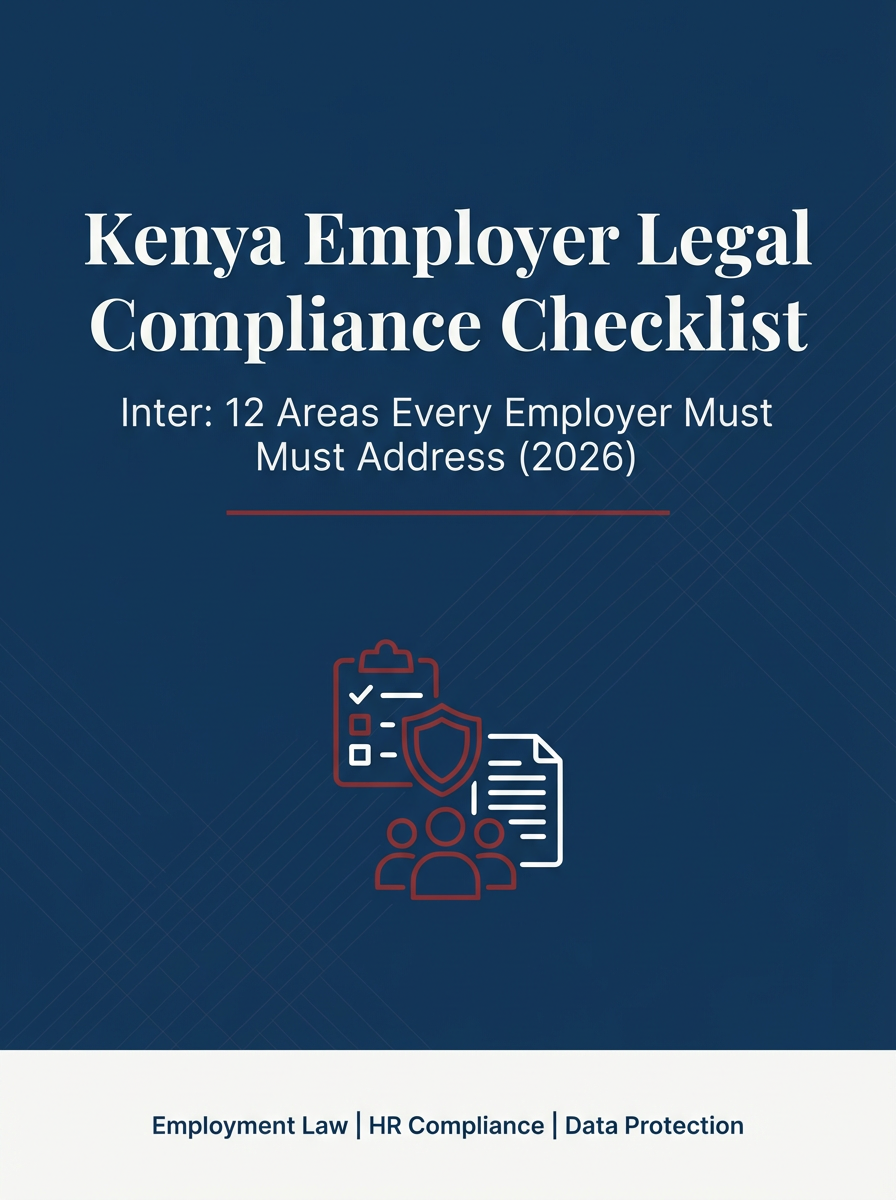
Kenya Employer Legal Compliance Checklist (2026)
A 12-area PDF checklist covering every employment compliance obligation for employers in Kenya, from pre-hire classification through to termination and post-employment obligations. Used by HR leads, COOs, and compliance teams at foreign companies expanding into Kenya.
Covers: classification, contracts, statutory deductions, work permits, HR data, discipline, termination, and more.
Download the Checklist (Free PDF)
You will receive the checklist by email. No spam.
FAQ
Do foreign companies need written employment contracts in Kenya?
Yes. Kenya’s Employment Act requires written contracts for most employment relationships. Using a home-country template without localisation can create enforceability gaps and compliance exposure.
What happens if we misclassify an employee as a contractor?
Misclassification creates exposure across three areas: unpaid statutory contributions and penalties, tax liability, and the risk of unfair dismissal claims on termination. Classification is determined by the substance of the relationship, not the label in the agreement.
Can we terminate an employee in Kenya without a formal process?
No. Kenyan employment law requires a procedurally fair process including notice of the allegation, a hearing, a written decision, and an opportunity to appeal. Skipping steps can result in an unfair dismissal finding even where the reason for termination is substantively sound.
Are non-compete clauses enforceable in Kenya?
They can be, but only if they are proportionate in scope, geography, and duration. Broad or poorly drafted non-compete clauses are regularly declined enforcement by Kenyan courts.
What data protection obligations apply to HR data in Kenya?
Employee data is subject to Kenya’s data protection framework. Employers should maintain HR privacy notices, appropriate vendor terms, and documented data handling policies. Biometric processing for attendance requires heightened care. Reference: ODPC.
Need an employment contract review or HR compliance audit for Kenya?
MN Legal supports foreign companies and growing SMEs with employment contract localisation, statutory compliance setup, work permit guidance, HR data governance, and termination procedure advice.
Disclaimer: This article provides general information and does not constitute legal or employment advice. Requirements can change and may depend on your sector, workforce structure, and operating model. Consult a qualified Kenyan employment lawyer for advice on your specific facts.