

MN Legal Insights

Table of Contents
A business can pay for a genuine expense, record it correctly and still land in a tax compliance problem. Here is why Kenya’s eTIMS compliance rules, and their effect on tax deductibility, deserve your attention long before the return is filed.
Picture Achieng, the finance manager of a growing Nairobi company. In March, her company buys office equipment worth KSh 250,000. The supplier delivers on time, the bank transfer goes through, and Achieng files the purchase order, the signed delivery note and the proof of payment in neat order. When the supplier mentions that he will send the eTIMS invoice “later”, she nods. She has a hundred other things to do, and the books already balance.
Months pass. Then the income tax return comes up, and with it an uncomfortable question: if KRA looks at this purchase, will it find what it expects to find?
That question carries far more weight today than it did two years ago, because the Kenya Revenue Authority (KRA) no longer takes a return at face value. It checks it. This is Achieng’s story, and quietly, it is the story of almost every business in Kenya.
Two sets of eyes on the same expense
An accountant and a tax officer can look at the same KSh 250,000 and ask different questions. The accountant asks whether the transaction was recognised and recorded properly. The tax officer asks whether it can be deducted, and whether the paper behind it says so in the way the law requires.
Section 15 of the Income Tax Act allows businesses to deduct expenditure incurred in producing income, subject to the Act’s conditions, while section 16 lists what cannot be deducted. Since the Finance Act 2023, electronic invoicing through KRA’s electronic Tax Invoice Management System (eTIMS) has been woven into that picture. KRA’s guidance states that from 1 January 2024, business expenditure generally has to be supported by an electronic tax invoice to qualify for deduction, subject to the exceptions in the law.
Achieng’s books answer the first question beautifully. The second hangs on a document she does not yet have.
A reliable accounting entry is only one part of a defensible tax deduction.
In fairness to the invoice, it cannot do everything. An eTIMS invoice does not make an expense deductible by itself. The expense must still be genuine, incurred for business purposes and properly classified. What the invoice does is prove the transaction to the tax authority in the form it expects.
The year the return met the records
For years, preparing the annual return meant gathering the books, adjusting for items that could not be deducted, and filing. That work still matters. What has changed is that somebody else now holds a copy of your transactions.
In a public notice dated 10 November 2025, KRA announced that from 1 January 2026 it would validate the income and expenses declared in individual and non-individual income tax returns against three sources: TIMS/eTIMS records, withholding income tax gross amounts and customs import records. The checks began with returns for the 2025 year of income. The notice adds that declared figures must be supported by valid electronic tax invoices, correctly transmitted with the buyer’s PIN where applicable, subject to the exceptions in section 23A of the Tax Procedures Act and the Tax Procedures (Electronic Tax Invoice) Regulations, 2024.
Then, in June 2026, came a breathing space. KRA allowed taxpayers filing 2025 returns to declare valid business expenses that lacked eTIMS invoices, uploading them at filing for validation afterwards. But the allowance covered 2025 only. From the 2026 year of income onwards, declared income and expenses must be backed by valid electronic invoices generated and transmitted through TIMS/eTIMS, subject to the legal exceptions. The relief was a bridge, not a destination, and anyone keeping 2026 records is already standing on the far side of it.
None of this means that a mismatch is a finding of fraud, or that the expense is automatically lost. It means the business must be able to explain the difference. Explaining it at the time of purchase takes one phone call. Explaining it a year later can take weeks.
“But we are not VAT-registered”: who must issue eTIMS invoices
It is the sentence we hear most often, and it is the most expensive misunderstanding in this whole area.
Electronic invoicing is not a VAT matter. Following the Finance Act 2023, it extends to persons carrying on business, whether or not they are registered for VAT. A consultancy, a retailer or a property business may carry eTIMS obligations even if it never charges a shilling of VAT. And as a buyer, each of them needs its suppliers’ invoices to support its own deductions. VAT registration and eTIMS compliance are separate questions with separate answers.
That is why eTIMS has stopped being a job for the tax desk alone. It reaches procurement, accounts payable, supplier selection and the filing cabinet. If you are a smaller business still finding its feet in Kenya, our legal roadmap for SMEs entering the Kenyan market is a useful companion read.
Why a bank transfer is not an eTIMS invoice
Back to Achieng’s folder. She has a bank transfer, a delivery note and a purchase order. Each tells part of the story: money moved, goods arrived, somebody approved. But none of them is the document the rules ask for.
A valid electronic tax invoice carries prescribed information. KRA’s guidance points to the seller’s PIN, the date and time of issue, the buyer’s PIN where applicable, a description and quantity of what was supplied, the invoice identifiers and QR code, and the tax rate, tax amount and total. The exact requirements depend on the regulations and the invoicing system in use.
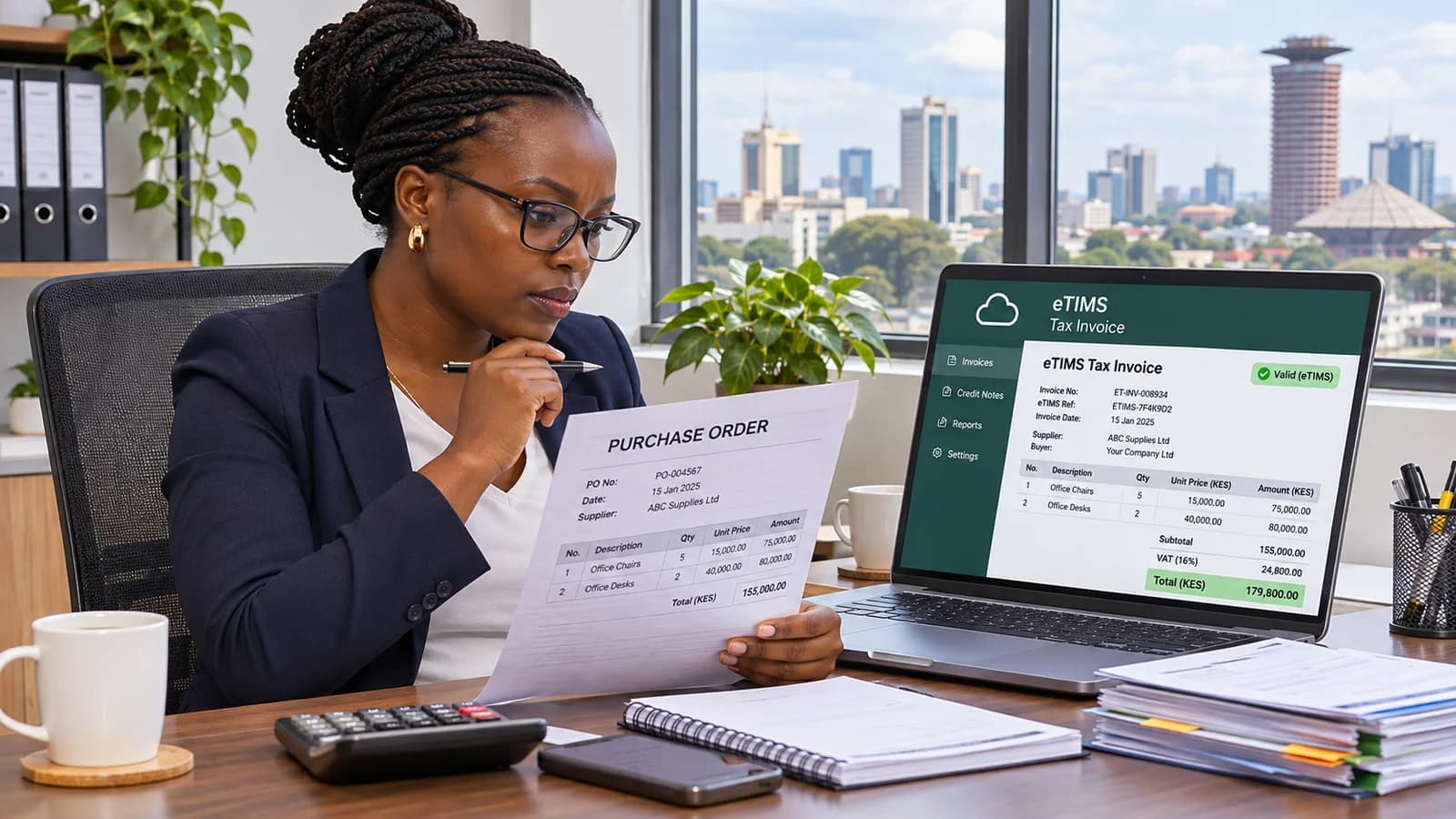
When an invoice does arrive, a careful buyer reads it the way a pilot reads a checklist. Are the supplier and buyer details right, including the buyer’s PIN? Do the description and amount match what was actually bought? Is the invoice genuine? KRA advises scanning the QR code or using the invoice number checker on iTax. And does it agree with the purchase order, the delivery note and the payment record? A few minutes of checking at the time can save weeks of reconstruction later.
When the supplier will not, or cannot, play along on eTIMS
Every finance team meets this supplier eventually: the small trader with a handwritten receipt, or the service provider who has never heard of eTIMS. The transaction is real. So is the compliance problem.
The instinct is to walk away from the supplier or write off the expense. Resist both. Begin by asking for a compliant invoice, and give the supplier your correct business name and PIN. When it arrives, verify it. If something is wrong, such as a mistaken PIN or amount, the fix normally runs through a credit note and a reissued invoice, not through a pen or an edited spreadsheet. Then check whether the purchase falls within an exclusion at all. And whatever happens, keep the trail: the purchase order, the contract, proof of delivery or completion, payment records and every message exchanged with the supplier. That trail shows what happened. But where no exclusion applies, it does not replace the invoice the law requires.
For the smallest suppliers, there is a purpose-built route. Where the seller is a small business or small-scale farmer with annual turnover not exceeding KSh 5 million, the buyer can raise the invoice on the seller’s behalf, as a buyer-initiated eTIMS invoice, through the eCitizen platform, so the purchase can be substantiated as a business expense. The seller is notified and must approve the invoice before it is transmitted through eTIMS, so the buyer needs accurate transaction details and the seller’s cooperation, and should confirm that both the supplier and the transaction qualify. This is different from reverse invoicing, which suits structured businesses with many small suppliers and needs a billing system integrated with eTIMS, together with KRA’s approval.
Neither route is a licence to create paperwork for something that never happened, or to manufacture documents after the fact. They exist to record real transactions, not to rescue missing ones.
Not every expense needs an eTIMS invoice: the exclusions
The law is not absolute here. Regulation 10 of the 2024 regulations, as summarised in KRA’s guidance, excludes a list of transactions from the electronic invoice requirement. These include emoluments such as salaries and wages, imports, investment allowances including internal accounting adjustments, airline passenger ticketing, interest and fees charged by financial institutions, expenses subject to withholding tax that is a final tax, services provided by a non-resident without a permanent establishment in Kenya, and other exclusions under section 23A of the Tax Procedures Act. For employee costs, which sit outside the invoice requirement, our guide to payroll compliance when hiring your first employee covers the payroll obligations that apply instead.
Two cautions apply. First, the withholding tax exclusion is narrow: it covers withholding tax that is a final tax, not every expense from which tax has been withheld. Second, being excluded from electronic invoicing is not the same as being deductible, because the ordinary income tax rules still apply. The discipline is to classify the expense, establish its legal treatment, and keep the records that support your conclusion.
Making eTIMS compliance a habit
The businesses that cope best with eTIMS rarely scramble at filing time. They have turned invoice checks into a habit that runs alongside the buying itself. They identify which purchases need an electronic invoice and which are excluded. They verify supplier details, buyer PIN and transmission status when the invoice arrives. They reconcile invoices with purchase orders, delivery notes, supplier statements and the ledger. They resolve gaps while the supplier is still easy to reach. And they document everything, including the reason for any exclusion they rely on. A smaller firm can begin with a structured spreadsheet and a monthly review, while a larger one can build the same checks into procurement policy, supplier contracts, payment approvals and system controls.
Before filing, one last walk-through pays for itself. Does declared income reconcile with sales records and eTIMS data? Are purchases backed by invoices or by a recognised exclusion? Do withholding tax records agree with what was declared? Is import expenditure supported by customs documents? Have cancelled, duplicate and corrected invoices been handled properly? A difference is not proof that an expense is invalid, but it is a reason to look before KRA does.
Two endings for Achieng
Suppose the supplier never sends that invoice, and no exclusion applies. The KSh 250,000 expense may be disallowed. At the 30% corporate rate, that is roughly KSh 75,000 of additional tax, before any penalties and interest.
Now imagine a second version of the story. Achieng’s company has one simple rule: no supplier is paid until a verified eTIMS invoice is on file. The invoice is requested on delivery, checked against its QR code, matched to the purchase order and filed with the payment. When return time arrives, the deduction is already defensible.
Same equipment. Same money. The only thing that changed was the process.
The invoice is part of the control system
An electronic tax invoice looks like a small administrative document. In practice, it links the supplier’s sale to the buyer’s records and feeds the data KRA uses to check returns. It does not make every expense deductible, and a discrepancy does not make every expense disallowed. What has changed is that records must now be reconcilable, verifiable and explainable.
One transaction. Two sides of the ledger. One invoice that matters to both.
eTIMS and tax deductibility: quick answers
Does an eTIMS invoice make an expense tax deductible?
No, not by itself. The expense must still be genuine, incurred for business purposes and properly classified. What the eTIMS invoice does is prove the transaction to KRA in the form it expects.
Do I need eTIMS invoices if I am not VAT-registered?
Possibly, yes. Electronic invoicing extends to persons carrying on business whether or not they are registered for VAT, and as a buyer you need your suppliers’ invoices to support your own deductions.
What if my supplier will not issue an eTIMS invoice?
Ask for a compliant invoice with your correct business name and PIN, verify it, and check whether the purchase falls within an exclusion. For small suppliers with annual turnover not exceeding KSh 5 million, the buyer can raise the invoice through eCitizen, subject to the seller’s approval. Keep the full paper trail either way.
Which expenses are excluded from the eTIMS invoice requirement?
The list includes salaries and wages, imports, airline passenger ticketing, interest and fees charged by financial institutions, expenses subject to final withholding tax, and services from non-residents without a permanent establishment in Kenya. An exclusion from invoicing is not the same as a deduction, because the ordinary income tax rules still apply.
From when must declared expenses be backed by eTIMS invoices?
KRA allowed a one-off relief for 2025 returns. From the 2026 year of income onwards, declared income and expenses must be supported by valid electronic invoices generated and transmitted through TIMS/eTIMS, subject to the legal exceptions.
Is your business ready for eTIMS validation?
If you are unsure whether your invoicing records are complete, how supplier expenses should be treated, or whether your books reconcile with KRA’s data, a structured compliance review can find the gaps and set out practical fixes.
MN Legal advises businesses on Kenyan tax compliance, legal risk management and the controls that support responsible operations.
Contact MN Legal to discuss an eTIMS compliance review, invoice and expense reconciliation, or practical tax documentation procedures for your business.